
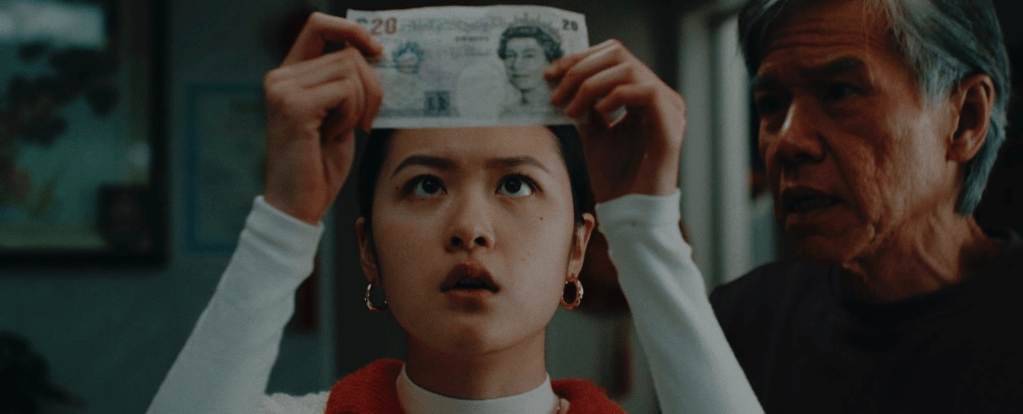
An interview with Calif Chong, Isabella Wei & Matthew P. Scott at the London Film Festival 2025
For Calif Chong, who was inspired to be a filmmaker by the Hong Kong comedies of her childhood, « comedy is a universal language. » This belief is at the heart of High Wire—her debut feature film, which offers a fresh and unifying perspective on the immigrant experience. The film follows Go-Wing (played by Isabella Wei), a British-Chinese young woman who finds solace and freedom through the practice of high-wire walking in a local circus in Yorkshire. The film is a poignant and visually stunning tale about community, resilience, and the possibilities that hide in the cracks of any creative space.
During the London Film Festival, where High Wire world-premiered last month, I had the privilege of meeting Calif Chong, along with the film’s cinematographer, Matthew P. Scott, and lead actress Isabella Wei, known for her roles in Netflix productions like The Crow and 1899. The atmosphere around them was charged with a sense of camaraderie, a bond forged in the exciting, chaotic journey of bringing a first feature film to life.
Marie (MP): Calif, given how sensitive immigration has become in the UK and the rising anti-immigration sentiment, what made you decide to approach this story through comedy?
Calif Chong (CC): I thought it would be a refreshing angle to tell an immigrant story while making people laugh. I grew up in Hong Kong where comedies shaped my cinematography. For me, this genre has the unique ability to connect individuals… which is why the world needs it more than ever, especially for such polarizing topics.
Isabella Wei (IW): With everything that is happening in the UK right now, making another dark, tragic and painful story would not be making the lives of the immigrants who would relate to the story any justice. As Calif said “comedy is a universal language”; and, in High Wire, it ties English and Cantonese together–the two languages in which the movie is filmed–while bringing a precious realness to the story.
MP: Calif, you decided to tell the story of Go-Wing’s emancipation through her encounter with a local circus, which gave birth to quite a unique metaphorical story… How did you first come up with this idea?
CC: I moved from Hong Kong to the UK in 2016 with the very clear goal of taking my filmmaker career to the international scene. Then, when my boyfriend, Matthew (the film’s cinematographer–Ed.)–who became my husband in the meantime–introduced me to Djonny Chen, our producer, I knew how great of an opportunity it would be for me. During our first meeting, he told me his dream was to make a movie set in a circus. I had never thought about it… but I found the idea exciting! My wish had always been to make a feature film about the immigrant experience taking place in a Chinese restaurant. It mutated into a takeaway place to give Go-Wing the possibility to go out and encounter the circus… This is how I allowed two perfectly foreign worlds to meet.
MP: And, why did you end up choosing high wire as the specific focus of the film?
CC: True, Go-Wing could have picked any circus art… but high wire was the most interesting to me. One of the reasons was that, apart from Robert Zemeckis who dedicated The Walk (2015) to the high-wire french artist Philippe Petit, this art has almost never been portrayed on screen. I thought: what if our low budget indie debut feature tried it? But most importantly, high wire perfectly symbolizes the liberating effect this art practice has on Go-Wing’s life. I married the story together along the lines of this revelatory metaphor.
M: Matthew, what form did your artistic collaboration take with Calif throughout the making of the movie?
Matthew P. Scott (MPS): The main beauty of us being partners and collaborating on this film is that I was involved in the process from the beginning. Thus, as scenes were developing we would simultaneously discuss how to film them; the narrative and the visual aspects took shape together. This collaboration throughout the writing process with Calif and Jackie Lam (the co-writers, Ed.) was a very precious asset to the film in my opinion.
MP: And as the film’s director of photography, what vision did you want to bring to the story of Go-Wing?
MPS: From a cinematography point of view, I really wanted to represent Go-Wing’s perspective, because ultimately, the film is tied to her personal journey. In this perspective, I tried to bring out the feeling of transcendence she experiences in the circus, and emphasize its contrast with the grounded and harsh sentiments conveyed by the Chinese takeaway. They both represent Go-Wing’s conflicting state of mind in the movie.
MP: Isabella Wei, your career has so far been marked by large-scale film productions such as the Netflix productions 1899 (2022) or Black Doves (2024), and blockbuster The Crow (2024)… What brought you to act in High Wire?
Isabella: I found out about this project through my agent. She got me a casting for the role of Go-Wing and I fell in love with her story. It is such a unique tale about circus acts and the immigration experience, I had never heard about anything like it before! My personal history also naturally drew me to the film: I come from Hong-Kong and Go-Wing’s experience of being an Asian girl living in the UK resonated with me in a singular way.
MP: Were they things you enjoyed about High Wire being a smaller scale film production?
Isabella: Yes, many things actually. Throughout the whole process, I realised how much I had been craving that tight-knit, low-budget, high-connection type of project. Playing in Netflix shows may be amazing–the production is smooth, there are no bumps and no problems–but I felt so much more connected to the crew and the other actors on this project than I have ever had. We were in the middle of North Yorkshire with no one else around besides our crew of 20-30 people max, and spent all of our days together. It was like a big two-week-long sleepover in the middle of nowhere… although a slightly more stressful version of it.
M: On this note, everyone knows how difficult the making of a first feature film can be…Can you tell us about the biggest challenges you encountered during the shooting of the movie?
MPS: It is hard to think about things that were not challenging! As all good directors do, Calif was pushing hard to get the most out of everything; there are no pointless scenes in the final movie… but that also means that every scene was very stressful to shoot. Being in Yorkshire revealed itself as a challenge: while we were all travelling up there, it started to snow and we truly thought we were not going to be able to shoot the next day. Our costume designer got stuck and had to abandon her car, walk to us, and get it towed in the morning… And that was just day one.
CC: Despite being a small, low-budget film, it was new and very important for me. I cared about every single tiny detail, and even though the film was so challenging to make, I also wanted everyone to have a good time. Everyday, I would literally have to hide in a corner and cry. Fortunately, we hired the best team, and Isabella really set the tone. A crew member told me it was the first time he had seen actors and crew members being so connected.
MPS: At the end of the day, the real testament to the incredible quality of all the crew and cast members is that none of the hardships we went through to make the film show on screen. And it’s not just me saying it…
 The Witchness
Laisser un commentaire